'/%3E%3Cpath fill='%23ffffff' transform='translate(256 256) scale(0.6) translate(-256 -256)' d='M501.1 395.7L384 278.6c-23.1-23.1-57.6-27.6-85.4-13.9L192 158.1V96L64 0 0 64l96 128h62.1l106.6 106.6c-13.6 27.8-9.2 62.3 13.9 85.4l117.1 117.1c14.6 14.6 38.2 14.6 52.7 0l52.7-52.7c14.5-14.6 14.5-38.2 0-52.7zM331.7 225c28.3 0 54.9 11 74.9 31l19.4 19.4c15.8-6.9 30.8-16.5 43.8-29.5 37.1-37.1 49.7-89.3 37.9-136.7-2.2-9-13.5-12.1-20.1-5.5l-74.4 74.4-67.9-11.3L334 98.9l74.4-74.4c6.6-6.6 3.4-17.9-5.7-20.2-47.4-11.7-99.6.9-136.6 37.9-28.5 28.5-41.9 66.1-41.2 103.6l82.1 82.1c8.1-1.9 16.5-2.9 24.7-2.9zm-103.9 82l-56.7-56.7L18.7 402.8c-25 25-25 65.5 0 90.5s65.5 25 90.5 0l123.6-123.6c-7.6-19.9-9.9-41.6-5-62.7zM64 472c-13.2 0-24-10.8-24-24 0-13.3 10.7-24 24-24s24 10.7 24 24c0 13.2-10.7 24-24 24z'/%3E%3C/svg%3E)
20 Practical Ways to Improve Google Rankings and AI Search Visibility
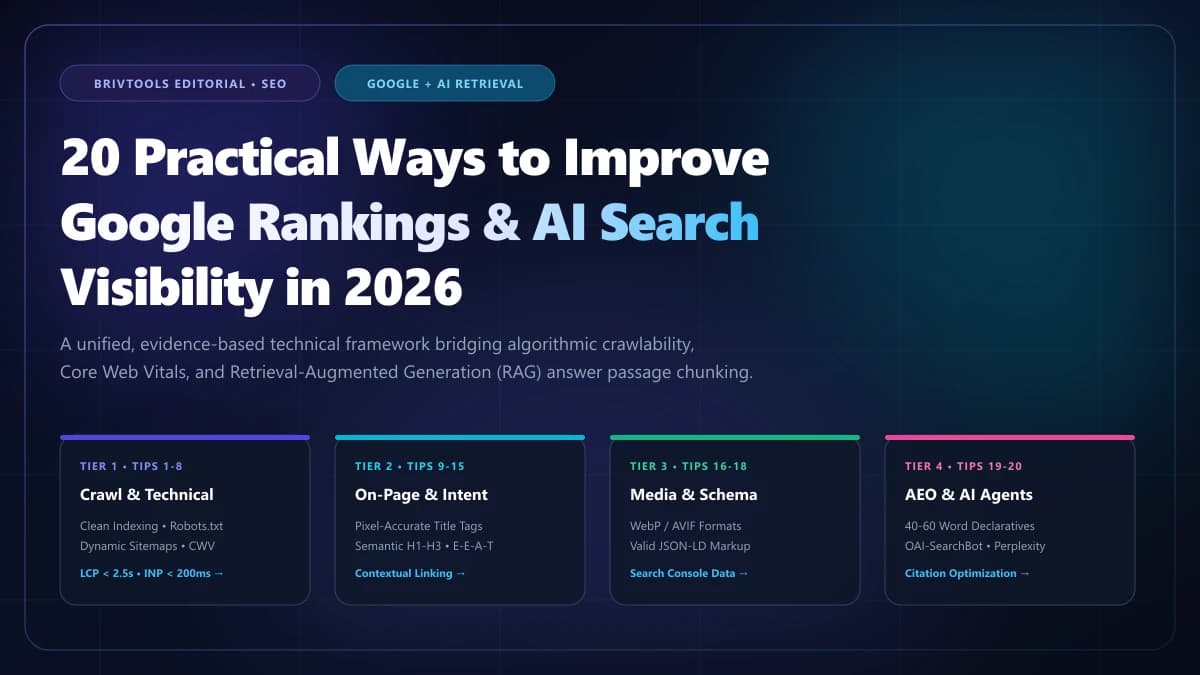
Executive Summary: The Dual Retrieval Paradigm Shift
Modern search engine indexation operates through automated rendering pipelines that allocate constrained computational budgets to crawl, parse, and render client-facing web applications. Simultaneously, generative artificial intelligence platforms ingest web indices to synthesize real-time answers with source attribution.
Rather than operating as opposing disciplines, traditional algorithmic SEO and modern Answer Engine Optimization (AEO/GEO) rely on the identical technical foundation: clean server-side crawlability, deterministic HTML delivery, unambiguous document outlines, and verifiable information density. If content cannot be discovered cleanly by traditional crawlers, it cannot be indexed or cited by generative AI models.
Traditional Search Engines vs. AI Generative Answer Engines
Search queries regarding organic ranking enhancement have undergone an architectural divergence. Website owners must engineer content for two parallel discovery architectures:
| Dimension | Traditional Google SEO | AI Answer Engines (AEO / GEO) |
|---|---|---|
| Output Delivery | Ranked list of 10 blue links, featured snippets, knowledge panels. | Synthesized narrative answer with inline superscript citations. |
| Retrieval Mechanism | Inverted index query mapping, PageRank topological link graph. | RAG pipelines, dense vector similarity, neural passage re-ranking. |
| Optimal Content Chunk | Comprehensive thematic guides (1,500–3,500+ words). | Concise 40–60 word self-contained declarative answer passages. |
| Authority Signals | Backlink domain graphs, root domain age, anchor distributions. | Entity co-occurrence, factual consensus, verified first-hand data. |
| Primary Crawlers | Googlebot, Bingbot | OAI-SearchBot, PerplexityBot |
1. Crawlability, Technical Infrastructure & Core Performance
Before search engines can evaluate your relevance or AI models can synthesize your arguments, they must be able to discover, fetch, and parse your documents without encountering server bottlenecks or rendering timeouts.
Ensure Complete Crawler Accessibility and Clean Indexability
Every indexable document on your domain must return an unambiguous HTTP 200 OK status. Redirect chains (e.g., 301 $\to$ 301 $\to$ 200) deplete allocated crawl budgets, while soft 404s (pages returning HTTP 200 with "content not found" text) trigger indexation drops in Google Search Console. Audit internal redirects to resolve in a single hop.
Configure robots.txt to Manage Crawl Budgets Without Blocking Indexation Directives
A common webmaster mistake is adding a Disallow: /page/ rule to robots.txt while expecting it to remove the URL from Google’s index. If a page has incoming external links, Google can index the URL without fetching its contents. Furthermore, crawlers cannot see on-page <meta name="robots" content="noindex"> tags on disallowed URLs.
// Correct robots.txt configuration
User-agent: *
Allow: /
Disallow: /api/private/
Disallow: /admin/
Sitemap: https://www.brivtools.com/sitemap.xml
Inspect and validate your sitemap and robots directives with our XML Sitemap Inspector.
Maintain an Accurate, Dynamic XML Sitemap with Precise Timestamps
XML sitemaps serve as the primary discovery manifest for search crawlers. Never populate sitemaps with redirected URLs, non-canonical variants, or 404 pages. Ensure that the <lastmod> timestamp updates only when substantive content changes occur, avoiding automated timestamp modifications on minor cosmetic edits.
Eliminate Conflicting Canonicalization Signals
Google treats rel="canonical" as a suggestion rather than a command. If your canonical tag points to URL A, but your XML sitemap specifies URL B and internal anchor links point to URL C, Google’s algorithms will ignore your directive and select an arbitrary canonical URL, splitting your link equity.
Remove Client JavaScript Rendering & Hydration Bottlenecks
While Googlebot executes JavaScript, it renders complex Single Page Applications (SPAs) asynchronously in a deferred queue. If primary content, headings, and internal links require client-side JavaScript execution, crawlers may time out or index empty documents. Render primary editorial content as pre-built HTML (SSR or SSG) to guarantee instantaneous indexing.
Optimize Core Web Vitals (LCP < 2.5s, INP < 200ms, CLS < 0.1)
Core Web Vitals are confirmed Google ranking signals. In March 2024, Interaction to Next Paint (INP) permanently replaced First Input Delay (FID). Optimize Largest Contentful Paint (LCP) by compressing hero images into modern WebP/AVIF formats and preloading primary font files.
Ensure Absolute Content and Layout Parity for Mobile-First Indexing
Google indexes exclusively using its smartphone crawler (Googlebot-Mobile). If your responsive layout hides paragraphs, tables, or navigation links on mobile viewports to save space, those elements are completely eliminated from Google’s index. Ensure 100% text and markup parity across all screen dimensions.
Prune Duplicate, Low-Value, and Thin Indexable Pages
Publishing hundreds of automatically generated tag archives, faceted filter combinations, or thin 50-word stubs dilutes your site's overall quality score (Helpful Content System). Audit your indexable URLs via Search Console. Either apply noindex to low-utility pages or consolidate them with 301 redirects into comprehensive pillar guides.
2. On-Page Semantic Architecture & Content Quality
Once technical crawlability is established, search engines evaluate topical relevance, document clarity, and author credibility.
Match Content Explicitly to Multi-Stage Search Intent
Search intent is rarely single-faceted. A user querying "improve google rankings" seeks both high-level diagnostic frameworks (informational) and immediate execution checklists (practical/transactional). Structure your document so that conceptual definitions appear early, followed immediately by actionable steps.
Craft Compelling Meta Descriptions Tailored for Click-Through Rates
While meta descriptions do not directly influence rank position algorithms, they serve as your organic ad copy. A persuasive 140–155 character description with an active call-to-action boosts click-through rate (CTR), generating positive user engagement signals.
Establish Semantic Heading Hierarchies That Support Machine Parsing
Organize your document with exactly one <h1> element representing the primary topic, followed by sequential <h2> and <h3> tags. AI models and search algorithms rely on heading trees to decompose long documents into semantic passages for passage indexing and RAG chunking.
Build a Contextual Internal Link Architecture with Descriptive Anchors
Internal links distribute PageRank equity across your domain and clarify semantic entity relationships. Never use generic anchors like "click here" or "learn more". Instead, embed keyword-rich anchors (e.g., "WCAG color contrast ratio checker") directly within explanatory body copy.
Incorporate Verifiable First-Hand Experience and E-E-A-T Signals
Google’s Search Quality Rater Guidelines heavily reward Experience, Expertise, Authoritativeness, and Trustworthiness (E-E-A-T). Demonstrate real-world implementation through original screenshots, code repositories, author credentials, and methodology disclosures.
Create Original, Information-Dense Research and Comparative Data
LLMs and human writers naturally link to original data sources. Publishing benchmark tests, structured comparison tables, and proprietary testing results creates an evergreen source of organic editorial backlinks and AI citations.
3. Media, Structured Data & Search Diagnostics
Implement Descriptive Image Alt Attributes & Modern Media Formatting
Images contribute significantly to Google Image Search traffic and overall page experience. Serve compressed WebP or AVIF formats with explicit width and height dimensions to prevent Cumulative Layout Shifts (CLS). Add descriptive, context-specific alt text for screen readers and search crawlers.
Implement Valid JSON-LD Structured Data Without Entity Over-Optimization
Structured data allows search engines to identify entities, authors, and document types unambiguously. Deploy Schema.org standard JSON-LD (Article, BreadcrumbList, FAQPage). Avoid misleading or hidden schema markups that violate Google's rich result spam guidelines.
Monitor Indexation Coverage and Query Signals in Google Search Console
Third-party SEO metrics are estimates; Google Search Console (GSC) provides primary empirical data. Review the Page Indexing report weekly to diagnose excluded URLs ("Crawled - currently not indexed", "Discovered - currently not indexed"). Track search query CTR trends to identify high-impression, low-click metadata optimization opportunities.
4. Answer Engine Optimization (AEO) & AI Search Retrieval
Generative answer engines (ChatGPT Search, Perplexity, Google AI Overviews) rely on passage extraction algorithms that reward concise, verifiable factual declarations.
Structure Declarative, Self-Contained Answer Blocks for AI and Passage Retrieval
RAG pipelines chunk documents into standalone semantic vectors. When answering a question (e.g., "What is INP?"), provide a direct, unambiguous 40-to-60 word declarative statement immediately beneath the heading before expanding into background context.
"Interaction to Next Paint (INP) is a Core Web Vital metric that evaluates overall page responsiveness by measuring the latency of all discrete user interactions—such as clicks, taps, and key presses—throughout a session. An INP score below 200 milliseconds confirms good responsiveness."
Explicitly Differentiate and Manage Bot Directives for Search Engines vs. AI Training Agents
Webmasters must distinguish between conversational search crawlers (which drive live citations and referral visits) and foundational training bots (which scrape content to train offline neural network weights). Configure your robots.txt deliberately based on your intellectual property strategy.
5. Major AI Retrieval User-Agents & robots.txt Matrix
| User-Agent | Operator | Primary Purpose | Recommended Policy |
|---|---|---|---|
| Googlebot | Organic search indexing and AI Overviews retrieval. | Allow 100% | |
| OAI-SearchBot | OpenAI | Real-time web search for ChatGPT Search citations. | Allow (for citations) |
| PerplexityBot | Perplexity AI | Real-time web search indexing for answer citations. | Allow (for citations) |
| GPTBot | OpenAI | Harvests data to train foundational LLM models. | Disallow (if guarding IP) |
| ClaudeBot | Anthropic | Model training and web data ingestion. | Disallow (if guarding IP) |
6. Practical Webmaster Pre-Flight Checklist
7. Frequently Asked Questions
How do Google rankings differ from AI search engine visibility (AEO/GEO)?
Traditional Google ranking relies on PageRank, on-page topical authority, and crawler indexation to deliver 10 blue links and rich snippets. AI search engines (like ChatGPT Search, Perplexity, and Google AI Overviews) use Retrieval-Augmented Generation (RAG). They ingest crawled web content, decompose pages into semantic vector embeddings, and re-rank 40–60 word declarative factual passages to synthesize answers with attribution citations. While the discovery and crawling foundations are identical, AI visibility requires self-contained factual clarity and information density.
Does llms.txt help my website rank higher on Google?
No. llms.txt is a community-proposed markdown summary file for AI context windows. Google Search Central has confirmed that Googlebot does not parse or factor llms.txt into its ranking algorithms. While maintaining an llms.txt file may provide clean context to specialized developer agents, standard XML sitemaps and schema markup remain the authoritative discovery mechanisms for search engines.
Should I block GPTBot in robots.txt?
It depends on your business objectives. GPTBot is OpenAI's web crawler used to harvest foundational model training data. Blocking GPTBot prevents your content from being used to train future model weights. However, if you want your site to be cited in live conversational queries on ChatGPT Search, you should permit 'OAI-SearchBot', which handles real-time web retrieval rather than model training.
Why is Interaction to Next Paint (INP) critical for SEO in 2026?
In March 2024, Google officially replaced First Input Delay (FID) with Interaction to Next Paint (INP) as a Core Web Vital. INP measures overall page responsiveness to user clicks, taps, and keyboard inputs throughout the entire page lifecycle. Sites with heavy main-thread JavaScript execution suffer poor INP (> 200ms), which directly degrades Google page experience evaluations.
Can I guarantee inclusion in Google AI Overviews or ChatGPT citations?
No legitimate SEO or agency can guarantee inclusion in synthetic AI answers. AI models evaluate query context, vector similarity, source consensus, and entity authority dynamically per query. However, structuring self-contained 40–60 word answer blocks directly below H2/H3 headers and providing verifiable first-hand data significantly maximizes retrieval probability.
Audit Your Sitemaps, Robots & Indexation Health with BrivTools
Validate XML sitemap URLs, detect redirect chains, inspect robots.txt crawl rules, and eliminate indexing bottlenecks with our free, zero-latency SEO suite.