'/%3E%3Cpath fill='%23ffffff' transform='translate(256 256) scale(0.6) translate(-256 -256)' d='M501.1 395.7L384 278.6c-23.1-23.1-57.6-27.6-85.4-13.9L192 158.1V96L64 0 0 64l96 128h62.1l106.6 106.6c-13.6 27.8-9.2 62.3 13.9 85.4l117.1 117.1c14.6 14.6 38.2 14.6 52.7 0l52.7-52.7c14.5-14.6 14.5-38.2 0-52.7zM331.7 225c28.3 0 54.9 11 74.9 31l19.4 19.4c15.8-6.9 30.8-16.5 43.8-29.5 37.1-37.1 49.7-89.3 37.9-136.7-2.2-9-13.5-12.1-20.1-5.5l-74.4 74.4-67.9-11.3L334 98.9l74.4-74.4c6.6-6.6 3.4-17.9-5.7-20.2-47.4-11.7-99.6.9-136.6 37.9-28.5 28.5-41.9 66.1-41.2 103.6l82.1 82.1c8.1-1.9 16.5-2.9 24.7-2.9zm-103.9 82l-56.7-56.7L18.7 402.8c-25 25-25 65.5 0 90.5s65.5 25 90.5 0l123.6-123.6c-7.6-19.9-9.9-41.6-5-62.7zM64 472c-13.2 0-24-10.8-24-24 0-13.3 10.7-24 24-24s24 10.7 24 24c0 13.2-10.7 24-24 24z'/%3E%3C/svg%3E)
Image EXIF Metadata & GPS Privacy Guide: Protecting Digital Footprints
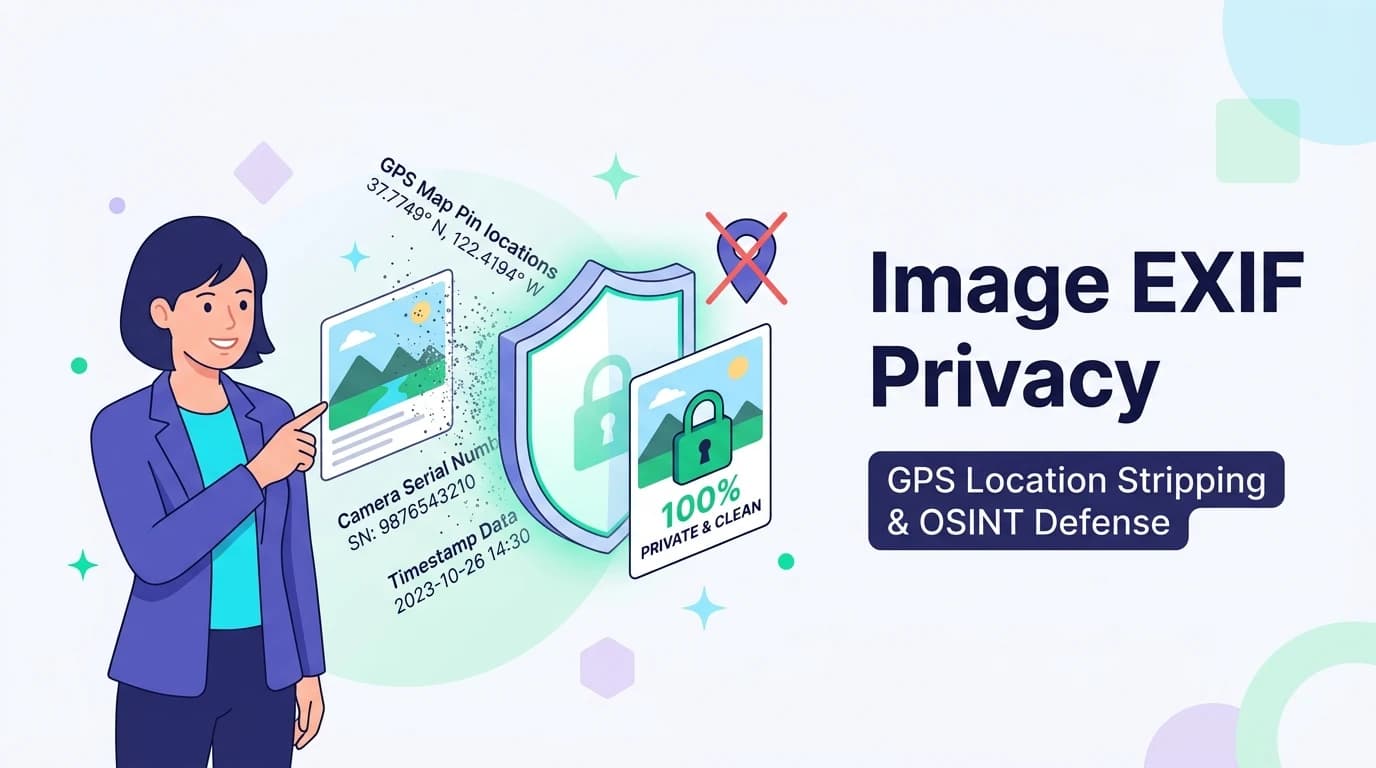
When you snap a photograph with a modern smartphone or DSLR, the resulting file is not merely a visual record. Embedded silently inside the binary header is an extensive metadata manifest known as Exchangeable Image File Format (EXIF).
1. The Anatomy of Image Metadata: EXIF, IPTC, and XMP Standards
Digital photographs typically encapsulate three distinct metadata specifications nested within binary application markers (such as JPEG APP1 markers):
| Standard | Created By | Typical Stored Payload | Privacy Sensitivity |
|---|---|---|---|
| EXIF (JEITA CP-3451) | JEITA / CIPA | GPS Latitude/Longitude, Altitude, Camera Model, Shutter Speed, Lens Serial | CRITICAL |
| IPTC-IIM | International Press Telecomm | Byline, Creator Name, Copyright, Editorial Headline, Location Name | HIGH (Identity Leak) |
| Adobe XMP | Adobe Systems | Photoshop Edit History, Document IDs, Face Recognition Regions | HIGH (Forensic History) |
2. High-Risk Payloads: GPS Geotags, Serial Numbers & Sub-Second Timestamps
When an investigator, adversary, or automated scraper extracts EXIF data via command-line tools like exiftool, here is what is revealed:
With a single click, anyone can copy those latitude and longitude coordinates into Google Maps or OpenStreetMap and zoom directly into the front porch, private bedroom, or clandestine meeting room where the photo was taken.
3. The Uncropped Embedded Thumbnail Hazard: When Redactions Fail
Perhaps the most startling vulnerability in photo security is the EXIF Embedded Thumbnail Leak.
Imagine a user takes a photo of an invoice on their desk. Realizing that their driver's license and credit card are visible on the periphery, they open a basic mobile editor, crop the image tightly around the invoice, and share the cropped file.
The Failure Mode: Most default photo editors only crop the primary pixel array. They never re-render the embedded thumbnail cached inside the EXIF metadata. Anyone who runs exiftool -b -ThumbnailImage photo.jpg > thumbnail.jpg can immediately recover the full, uncropped original picture showing the driver's license and credit card.
4. OSINT Exploitation Realities: Precision Geolocation Weaponization
In Open-Source Intelligence (OSINT) workflows, EXIF data is the first forensic artifact analyzed:
- Hardware Correlation: Because camera serial numbers and lens serial numbers are recorded, an investigator can link photos posted under different pseudonyms across disparate websites to the identical physical camera body.
- Routine Profiling: By collecting dozens of photos posted by a subject over time, automated scripts plot heatmaps revealing primary residence, work commute patterns, children's schools, and recurring weekend locations.
- Stalking & Doxxing: In classified item listings or community marketplaces, casual sellers inadvertently publish their home address to potential thieves alongside pictures of expensive jewelry, bicycles, or electronics.
5. Server-Side vs. Client-Side Stripping: Why Browser Memory Wins
When users want to strip metadata before publishing photos, many online utilities require uploading the unscrubbed photo to a remote server. This creates an immediate privacy paradox: You must send your unredacted GPS location and private photos to an untrusted third-party server to strip the data.
| Architecture | Network Transmission | Data Privacy Posture | Processing Latency |
|---|---|---|---|
| Traditional Web Cleaners | Uploads full multi-megabyte photo over HTTP to backend server | Third-party server can log or store sensitive GPS coordinates before stripping | Slow (upload + download cycle) |
| Client-Side HTML5 Canvas / WASM | ZERO bytes uploaded (0 network packets) | 100% Private; photo never leaves user browser memory | Instantaneous (Native GPU / RAM) |
6. Zero-Leak Metadata Stripping Implementation in TypeScript
The most reliable, zero-leak method for stripping 100% of EXIF, IPTC, and thumbnail artifacts is decoding the image to pure raw raster pixels in an off-screen HTML5 Canvas and exporting a clean, unannotated blob:
export async function stripImageMetadataClientSide(file: File): Promise<Blob> {
  return new Promise((resolve, reject) => {
    // 1. Create a transient Object URL for browser rendering
    const objectUrl = URL.createObjectURL(file);
    const img = document.createElement('img');

    img.onload = () => {
      // 2. Allocate offscreen canvas matched exactly to native dimensions
      const canvas = document.createElement('canvas');
      canvas.width = img.naturalWidth;
      canvas.height = img.naturalHeight;

      const ctx = canvas.getContext('2d');
      if (!ctx) {
        URL.revokeObjectURL(objectUrl);
        reject(new Error('Canvas context initialization failed'));
        return;
      }

      // 3. Draw raw pixels only — completely discards all EXIF/XMP/IPTC chunks
      ctx.drawImage(img, 0, 0);

      // 4. Export clean image blob with identical visual fidelity
      canvas.toBlob(
        (cleanBlob) => {
          URL.revokeObjectURL(objectUrl);
          if (cleanBlob) {
            resolve(cleanBlob);
          } else {
            reject(new Error('Image blob export failed'));
          }
        },
        file.type === 'image/png' ? 'image/png' : 'image/jpeg',
        0.95 // High quality preservation
      );
    };

    img.onerror = () => {
      URL.revokeObjectURL(objectUrl);
      reject(new Error('Failed to load image file'));
    };

    img.src = objectUrl;
  });
}
7. Frequently Asked Technical Questions
Do social media platforms like WhatsApp, X (Twitter), and Instagram automatically strip EXIF metadata?+
If you share an image as a 'file' or via cloud storage links with colleagues, clients, or on public forums (like Reddit, GitHub, or specialized forums), all GPS coordinates, camera serial numbers, and device fingerprints remain completely intact.
How accurate are smartphone EXIF GPS coordinates?+
Beyond basic latitude and longitude, smartphones record altitude, compass heading direction, speed, and exact GPS UTC timestamps down to fractions of a second. This allows investigators or stalkers to determine not only which building you entered, but the exact window or desk where the photo was taken.
What is the 'uncropped embedded thumbnail' security vulnerability?+
An attacker extracting the EXIF metadata can view the original uncropped, unblurred thumbnail. Sensitive documents, credit cards, faces, or surroundings that the user deliberately cropped out can be partially recovered from the EXIF preview stream.
Does converting a JPEG to WebP or PNG automatically remove EXIF data?+
Re-encoding an image by drawing it to an HTML5 Canvas and reading back the pixel blob natively discards all non-pixel metadata chunks, providing a deterministic zero-leak scrub.
Scrub Image Metadata Client-Side with 100% Privacy
Eliminate GPS geotags, camera serials, and hidden thumbnail leaks in your browser memory before sharing photos. Zero file uploads, zero server tracking.