'/%3E%3Cpath fill='%23ffffff' transform='translate(256 256) scale(0.6) translate(-256 -256)' d='M501.1 395.7L384 278.6c-23.1-23.1-57.6-27.6-85.4-13.9L192 158.1V96L64 0 0 64l96 128h62.1l106.6 106.6c-13.6 27.8-9.2 62.3 13.9 85.4l117.1 117.1c14.6 14.6 38.2 14.6 52.7 0l52.7-52.7c14.5-14.6 14.5-38.2 0-52.7zM331.7 225c28.3 0 54.9 11 74.9 31l19.4 19.4c15.8-6.9 30.8-16.5 43.8-29.5 37.1-37.1 49.7-89.3 37.9-136.7-2.2-9-13.5-12.1-20.1-5.5l-74.4 74.4-67.9-11.3L334 98.9l74.4-74.4c6.6-6.6 3.4-17.9-5.7-20.2-47.4-11.7-99.6.9-136.6 37.9-28.5 28.5-41.9 66.1-41.2 103.6l82.1 82.1c8.1-1.9 16.5-2.9 24.7-2.9zm-103.9 82l-56.7-56.7L18.7 402.8c-25 25-25 65.5 0 90.5s65.5 25 90.5 0l123.6-123.6c-7.6-19.9-9.9-41.6-5-62.7zM64 472c-13.2 0-24-10.8-24-24 0-13.3 10.7-24 24-24s24 10.7 24 24c0 13.2-10.7 24-24 24z'/%3E%3C/svg%3E)
JWT Decoding vs. Verification: Architecture, Vulnerabilities & Security Guide
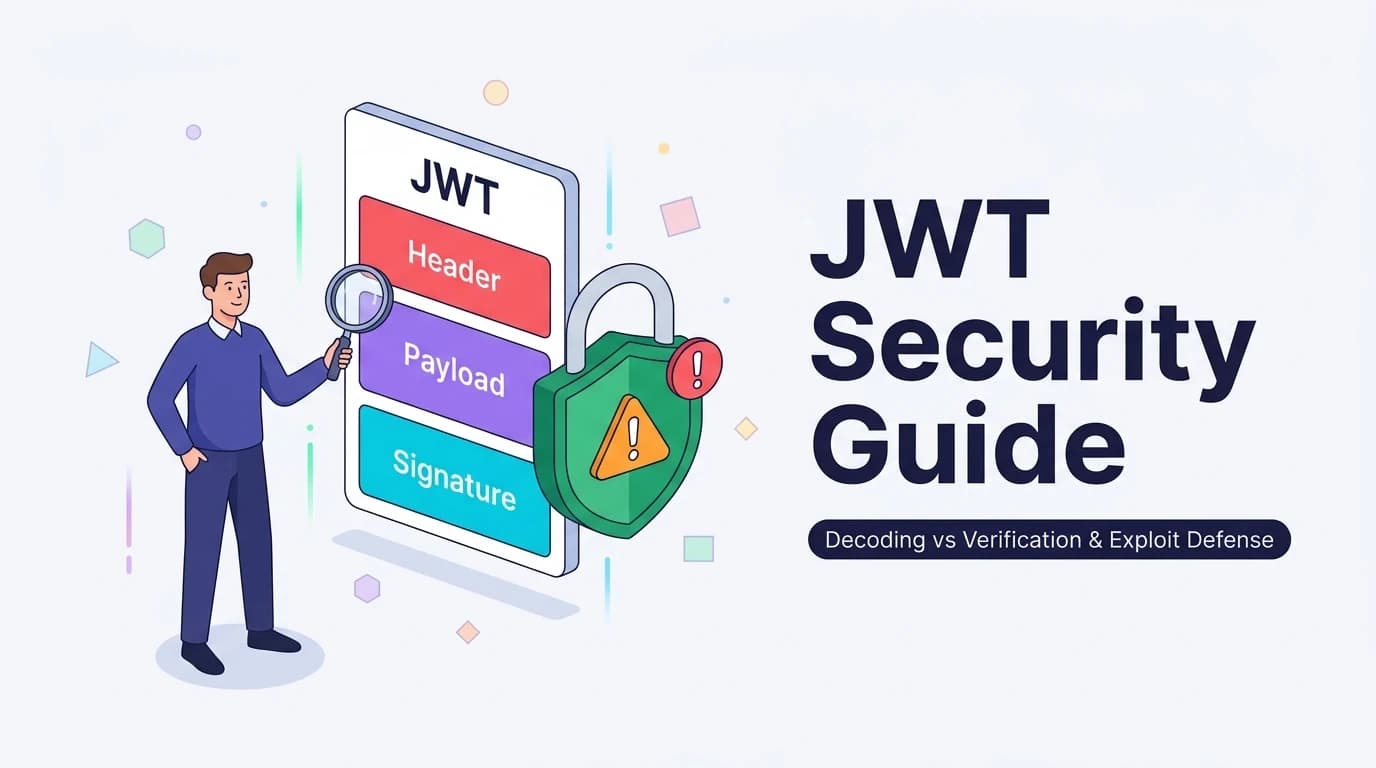
JSON Web Tokens (RFC 7519) are the backbone of modern stateless authentication across microservices, Single Page Applications (SPAs), and OAuth 2.0 / OpenID Connect (OIDC) architectures. Yet, an alarming number of software systems suffer from a foundational misconception: conflating token decoding with cryptographic verification.
1. The Anatomy of RFC 7519: Base64Url Is Not Encryption
A JSON Web Signature (JWS) compact serialization consists of three distinct segments separated by ASCII periods (.):
alg) and token type (typ)sub, role, exp)Critical Security Fact: Base64Url is an encoding standard, not encryption. It provides zero confidentiality. Anyone who captures or inspects this token can immediately view the entire JSON payload in cleartext. Never store database credentials, raw passwords, credit cards, or sensitive PII inside a JWS payload.
2. The Fatal Flaw: Decoding Payloads Without Verification
When developers build backend endpoints, microservice routing proxies, or API gateways, a recurring anti-pattern is using convenience methods such as jwt.decode(token) instead of jwt.verify(token, secretOrPublicKey).
The backend receives the token, splits it by ., parses the payload JSON, and trusts payload.role === 'admin' without checking the signature.
Result: Any malicious user can forge claims using a simple text editor and gain total administrative access.
The server takes the Base64Url header and payload, recomputes the expected hash using its trusted key, verifies the signature matches, checks exp and nbf, and validates the issuer.
Result: Tampered tokens are rejected immediately with HTTP 401 Unauthorized.
3. Exploit 1: Algorithm Confusion (RS256 to HS256 Attack)
Algorithm confusion (also known as the Key Confusion Attack) is one of the most devastating JWT implementation vulnerabilities. It exploits flawed verification logic in libraries that blindly trust the algorithm defined in the unverified token header.
Because RSA public keys are frequently distributed publicly (via /.well-known/jwks.json or SSL certificates), the attacker knows the exact byte sequence of the public key. When the flawed server executes HMAC-SHA256(header.payload, public_key_pem), the hashes match perfectly.
Always strictly enforce the expected algorithm in verification options. Explicitly supply algorithms: ['RS256']. Never permit the incoming token header to dictate cryptographic algorithm selection.
4. Exploit 2: The 'none' Algorithm Signature Bypass
RFC 7518 permits an unsecured JWS where "alg": "none". In unsecured tokens, the signature segment is empty (e.g., header.payload.).
Early versions of major JWT libraries treated none as valid if not explicitly disabled. Attackers forged payloads with elevated permissions, changed "alg": "none" (or variations like None, NONE), stripped the signature byte stream, and completely bypassed authentication.
5. Exploit 3: Key ID ('kid') Header Injection & Path Traversal
The optional "kid" (Key ID) header parameter tells the server which verification key to load when rotating multiple signing keys. However, if the server uses this parameter unsafely:
If key retrieval concatenates paths like fs.readFileSync('/keys/' + header.kid), an attacker sets "kid": "../../dev/null". The key resolves to an empty file (0 bytes). The attacker then signs the token using an empty HMAC secret "", successfully forging valid tokens.
If the key is fetched via dynamic SQL query: SELECT key FROM keys WHERE kid = '${header.kid}', an attacker injects ' UNION SELECT 'my-known-secret'-- to control the verification key entirely.
6. Safe Architectural Patterns: Client UI vs. Backend Zero-Trust
To build high-performance yet impenetrable web applications, implement strict separation of concerns across client and server boundaries:
| Layer | Allowed Operation | Strictly Prohibited | Security Posture |
|---|---|---|---|
| Frontend (Client SPA) | Decode exp to trigger silent token refresh; show username in navbar. | Never make authorization decisions or hide sensitive API routes based on decoded role claims. | Pure UX Enhancement (Untrusted) |
| API Gateway / Microservice | Cryptographically verify signature with JWKS; enforce strict algorithm allowlists; validate iss, aud, exp. | Never call unverified decode methods or accept arbitrary token header algorithms. | Zero-Trust Gatekeeper (Authoritative) |
7. Secure TypeScript Implementation & Signature Verification
Here is a robust, production-grade example using the industry-standard jose library (native Web Crypto API, zero external dependencies) demonstrating impenetrable token verification:
import { jwtVerify, createRemoteJWKSet } from 'jose';

// 1. Establish trusted Remote JWKS endpoint (OIDC / OAuth 2.0 Identity Provider)
const JWKS = createRemoteJWKSet(
  new URL('https://auth.company.com/.well-known/jwks.json'),
  {
    cooldownDuration: 30000, // 30s rate-limit cache protection
    timeoutDuration: 5000,
  }
);

interface CustomClaims {
  sub: string;
  role: 'admin' | 'editor' | 'viewer';
  tenantId: string;
}

export async function verifyAndAuthorizeToken(jwt: string): Promise<CustomClaims> {
  try {
    // 2. Strict cryptographic verification with locked algorithm & claims
    const { payload } = await jwtVerify(jwt, JWKS, {
      issuer: 'https://auth.company.com',
      audience: 'https://api.company.com',
      algorithms: ['RS256', 'ES256'], // Explicit allowlist! Rejects 'none' & HS256
      clockTolerance: '5s',           // Mitigate minor server clock drift
    });

    // 3. Type-safe verified claims extraction
    const claims = payload as unknown as CustomClaims;
    return claims;
  } catch (error) {
    // 4. Any tampered signature, expired claim, or mismatched algorithm throws
    console.error('Cryptographic verification failed:', error);
    throw new Error('Unauthorized: Invalid or tampered security token');
  }
}
8. Frequently Asked Technical Questions
Is it safe to decode a JWT on the frontend in client-side JavaScript?+
All sensitive operations, database mutations, and protected route access must strictly occur on the backend API gateway or server layer where the token's cryptographic signature is fully verified against trusted public keys (JWKS) or shared secrets. Client-side decoding is merely syntactic deserialization.
How does the RS256 to HS256 algorithm confusion attack work?+
If the verification library accepts any algorithm specified in the token header and passes the RSA public key to an HMAC verification routine, the HMAC algorithm treats the ASCII public key as the symmetric secret. Because the attacker possesses that exact public key, the attacker's forged signature matches the server's calculation, granting full unauthorized administrative access.
Why should sensitive data like passwords or PII never be placed in a standard JWT?+
Anyone who intercepts or possesses a JWS token can trivially decode the payload using standard Base64 deserializers without needing any secret key. To store sensitive claims securely, you must employ JWE (JSON Web Encryption) as defined in RFC 7516, which cryptographically conceals payload contents.
What is the recommended key rotation strategy for production JWTs?+
Never allow arbitrary 'jku' (JWK Set URL) headers from untrusted origins or unchecked 'kid' values that can cause directory traversal or SQL injection. Hardcode expected algorithms (e.g., exclusively ['RS256', 'ES256']) in the verification library options.
Inspect & Debug JWTs Client-Side with Zero Leak Risk
Safely inspect headers, claims, expiration timestamps, and signature status directly in your browser without transmitting sensitive tokens to any server.