'/%3E%3Cpath fill='%23ffffff' transform='translate(256 256) scale(0.6) translate(-256 -256)' d='M501.1 395.7L384 278.6c-23.1-23.1-57.6-27.6-85.4-13.9L192 158.1V96L64 0 0 64l96 128h62.1l106.6 106.6c-13.6 27.8-9.2 62.3 13.9 85.4l117.1 117.1c14.6 14.6 38.2 14.6 52.7 0l52.7-52.7c14.5-14.6 14.5-38.2 0-52.7zM331.7 225c28.3 0 54.9 11 74.9 31l19.4 19.4c15.8-6.9 30.8-16.5 43.8-29.5 37.1-37.1 49.7-89.3 37.9-136.7-2.2-9-13.5-12.1-20.1-5.5l-74.4 74.4-67.9-11.3L334 98.9l74.4-74.4c6.6-6.6 3.4-17.9-5.7-20.2-47.4-11.7-99.6.9-136.6 37.9-28.5 28.5-41.9 66.1-41.2 103.6l82.1 82.1c8.1-1.9 16.5-2.9 24.7-2.9zm-103.9 82l-56.7-56.7L18.7 402.8c-25 25-25 65.5 0 90.5s65.5 25 90.5 0l123.6-123.6c-7.6-19.9-9.9-41.6-5-62.7zM64 472c-13.2 0-24-10.8-24-24 0-13.3 10.7-24 24-24s24 10.7 24 24c0 13.2-10.7 24-24 24z'/%3E%3C/svg%3E)
USPS Cubic Pricing Explained: Calculate Your Box or Soft-Pack Tier
Calculate the tier before comparing label prices
USPS cubic pricing uses a package-size tier and destination zone for eligible commercial shipments. A tier such as 0.2 is a size bracket, not a shipping price and not a promise that cubic is the cheapest option.
For a rectangular box: round each outside inch measurement down to a quarter inch, multiply the three measurements, divide by 1,728, then select the containing tenth-cubic-foot tier.
The common mistakes happen around that formula: entering inside dimensions, applying ordinary decimal rounding to the result, using the box method for a flat non-pleated mailer, or relying on an old eligibility table. This guide walks through those decisions using current USPS sources reviewed November 1, 2026.
1. Check the service and packaging before doing the math
The current standards are in DMM 223 §1.3 for Priority Mail and DMM 283 §1.3 for Ground Advantage. For the supported rectangular-box calculation:
| Check | Priority Mail Cubic | Ground Advantage Cubic |
|---|---|---|
| Maximum cubic volume | 0.5 ft³ | 1.0 ft³ |
| Maximum packed weight | 20 lb | 20 lb |
| Longest outside dimension | 22 inches | 22 inches |
| Box tiers | 0.1 through 0.5 | 0.1 through 1.0 |
Rolls and tubes do not qualify for cubic prices. Commercial access, labeling, contents and other mailability rules still apply. A calculator checking dimensions and weight does not establish all of those conditions.
The July 12, 2026 USPS update raised the longest-side limit from 18 to 22 inches and reduced Ground Advantage soft-pack tiers to five. Check the date of a saved worksheet or older tutorial before reusing it.
2. Calculate a rectangular box tier step by step
Measure the packed parcel at its maximum outside points. Keep the original readings so you can reproduce the calculation and check actual eligibility limits before applying the pricing-rounding procedure.
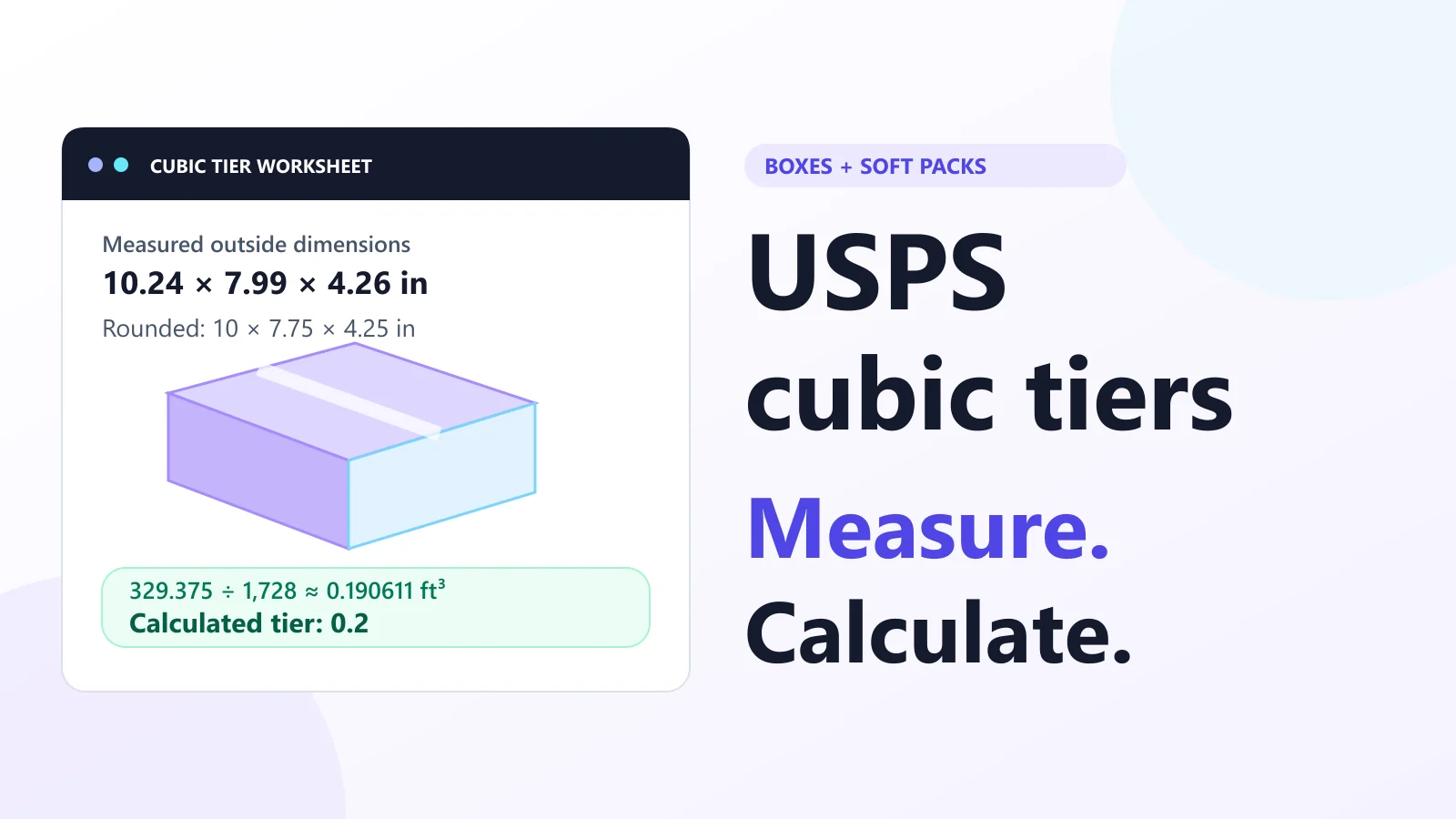
Worked example: 10.24 × 7.99 × 4.26 inches
- Round down separately: 10.24 becomes 10; 7.99 becomes 7.75; 4.26 becomes 4.25 inches.
- Multiply: 10 × 7.75 × 4.25 = 329.375 cubic inches.
- Convert: 329.375 ÷ 1,728 ≈ 0.1906105 cubic foot.
- Select tier 0.2 because the result is above 0.1 and at or below 0.2.
With an illustrative packed weight of 2 lb, this example clears the calculator's supported size and weight checks for both services. It still needs a current quote and the other shipment requirements.
rounded dimension = floor(inches × 4) ÷ 4
cubic feet = rounded length × rounded width × rounded height ÷ 1728
tier = smallest 0.1 bracket that contains the full result
The divisor comes from 12 × 12 × 12 cubic inches in one cubic foot. If your measurements are in centimeters, convert to inches before applying quarter-inch rounding. The USPS cubic tier calculator accepts inches or centimeters and shows its rounded measurements.
3. Keep enough precision to choose the right tier
A result close to 0.1 can be displayed as “0.10” while actually exceeding the tier boundary. Select the bracket from the full calculation; do not format the decimal first and then use the shortened display as your input.
| Outside box dimensions | Cubic inches | Cubic feet, approximately | Tier |
|---|---|---|---|
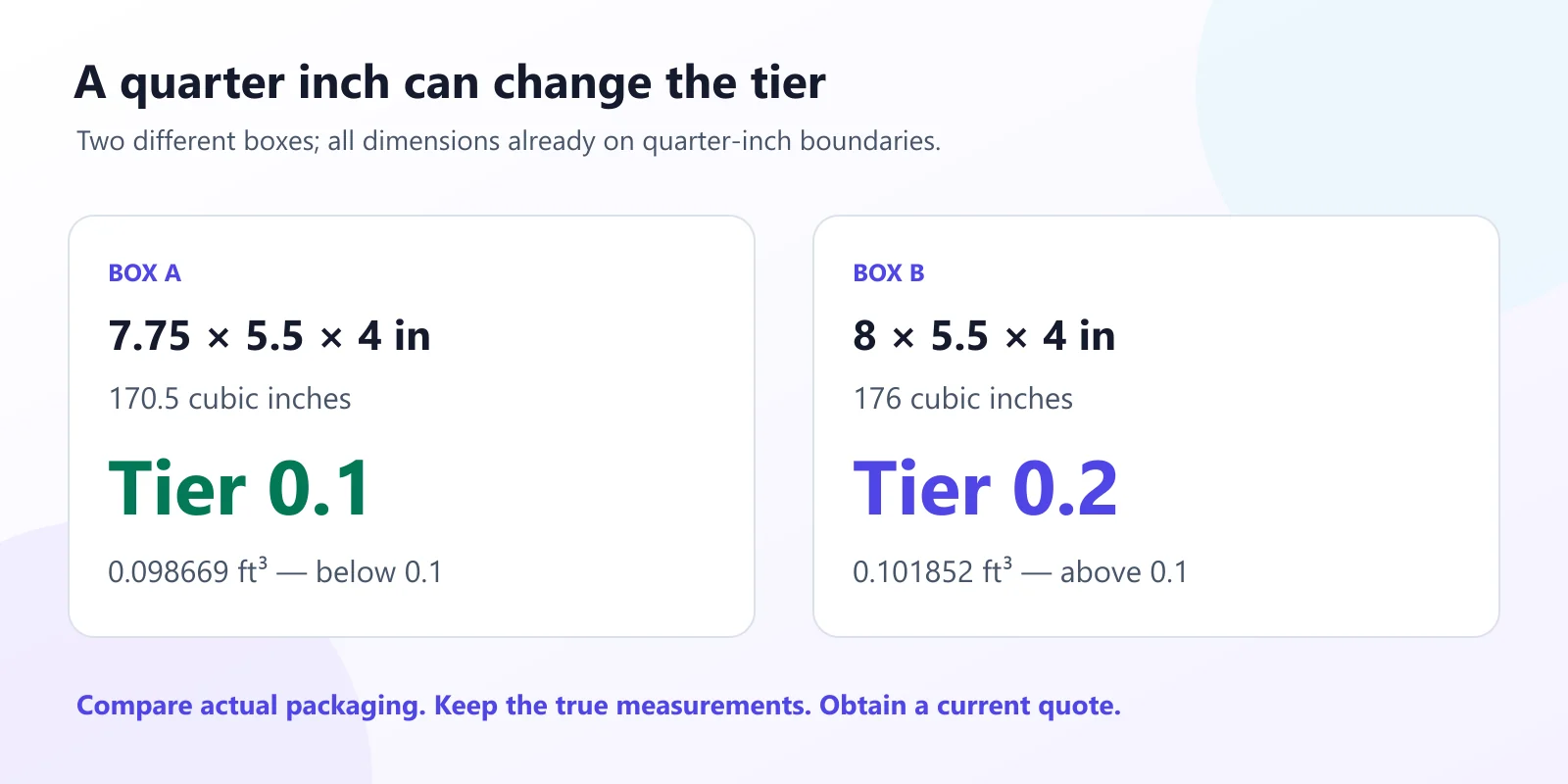
| 7.75 × 5.5 × 4 in | 170.5 | 0.098669 | 0.1 |
| 8 × 5.5 × 4 in | 176 | 0.101852 | 0.2 |
| 12 × 12 × 12 in | 1,728 | 1.000000 | 1.0, Ground Advantage only |
The first two examples differ by a quarter inch in one dimension but land in different brackets. That is a reason to compare actual packaging options, not to understate a measurement. An exact boundary stays in its bracket: exactly 0.2 belongs to tier 0.2; a value greater than 0.2 enters the next bracket.
4. Use the flat-pack method only for suitable soft packaging
Non-pleated soft packs and padded envelopes use the original packaging's outside flat length plus width, rounding each measurement down to a quarter inch first. Pleated or expandable packaging follows the parcel measurement method instead. Do not force a gusseted bag into a flat-pack calculation.
| Rounded flat length + width | Tier |
|---|---|
| Up to 21 in | 0.1 |
| Over 21 through 27 in | 0.2 |
| Over 27 through 31 in | 0.3 |
| Over 31 through 34 in | 0.4 |
| Over 34 through 36 in | 0.5 |
For an illustrative non-pleated pack measuring 15.2 × 12.2 inches before packing, the rounded dimensions are 15 and 12. Their sum is 27 inches, giving tier 0.2. That result is not a literal box-volume measurement and does not prove that the contents fit safely.
Check the original packaging and the finished mailpiece against the applicable USPS requirements. In the calculator, choose Non-pleated soft pack only for that method. Do not extend the table to box tiers 0.6–1.0.
5. Separate the space your product needs from the space USPS measures
Use inside dimensions to assess product fit and outside dimensions for the postal calculation. Ask a packaging supplier which dimensions its catalog lists, then measure the finished package rather than assuming those labels are interchangeable.
Suppose a product measures 7 × 5 × 2 inches and you choose 0.25 inch of clearance on every side. A rectangular fit check needs at least 7.5 × 5.5 × 2.5 inches inside, in a suitable orientation. That clearance is an arithmetic example, not a packaging-protection specification for every product.
The calculator's box comparison accepts separate internal and external dimensions, permits axis rotation and applies your chosen clearance on both sides. It can narrow a catalog of candidate boxes, but it cannot evaluate fragile contents, cushioning performance, closure strength or real soft-mailer fit.
If it suggests a smaller outside dimension to reach another tier, treat that as a planning target for a different suitable box. Confirm that the product and protective materials still fit, then remeasure the actual packed result.
6. Audit package measurements by SKU
A package catalog is easier to maintain when original measurements, units and product IDs stay together. Open Batch packages (CSV) in the cubic calculator and start with its template:
sku,type,length,width,height,weight,unit,weight_unit
BOX-A,box,10.24,7.99,4.26,2,in,lb
MAILER-A,soft,15.2,12.2,,2,in,lb
REVIEW-WEIGHT,box,8,5.5,4,21,in,lb
Illustrative data. The final row exceeds the cubic packed-weight limit and belongs in the review list.
Use box or soft for packaging, in or cm for measurements, and lb or kg for weight. The soft-pack row leaves height blank because its supported calculation uses two flat measurements.
Export the results and review ineligible and invalid rows before replacing catalog data. Keep a copy of the original input, the rules-review date and the physical remeasurement. All calculations and CSV processing run in your browser; the tool does not buy labels or update your store.
If the same SKUs are used in your product feed, keep packaging and image audit fields separate. Our Merchant Center image-size repair guide shows a related product-ID workflow for image URLs; an image check does not verify shipping dimensions.
7. Check the packed parcel and obtain the actual quote
Before buying a label, confirm the packaging method, actual exterior, packed weight and destination. Compare current eligible service quotes through your shipping provider. The USPS Notice 123 price list is a reference for published prices; your provider's applicable commercial quote and shipment details still matter.
Do not reuse cubic rounding for an unrelated pricing procedure. Dimensional-weight calculations and other parcel fees have their own rules; DMM 283 separates those sections from cubic pricing. Likewise, this calculator does not price USPS Flat Rate containers or handle every nonrectangular parcel.
Keep the quote with the package record so a later adjustment can be investigated against the exact measurements and label data used. A smaller tier is useful information for comparing options, but it is not a substitute for a safe package or a current rate.
Frequently asked questions
How do I calculate a USPS cubic tier for a box?+
Do not round the displayed decimal to one digit before selecting a bracket. A computed 0.10185 cubic foot belongs in tier 0.2, not 0.1. Check the service's size, packed-weight and commercial eligibility separately.
Is the longest-side limit 18 inches or 22 inches?+
An older article or saved spreadsheet may still use 18 inches. The current limit does not remove the weight, volume or other mailability requirements. Keep the actual outside measurement rather than editing it to satisfy a calculator.
Do Ground Advantage soft packs still have tiers through 1.0?+
The 1.0-cubic-foot Ground Advantage box limit is a different measurement path. Choose the correct packaging mode; pleated or expandable mailers use parcel measurements rather than the non-pleated flat-pack method.
Is cubic pricing always cheaper than another label option?+
BrivTools calculates the tier and supported size/weight checks, not a dollar rate. Consider packaging costs, protection and the delivery requirements of the order as well as the quoted postage.
Should I enter the dimensions printed on the box?+
Internal dimensions help assess whether the product and protective material fit. Wall thickness, closure and bulging can change the exterior, so a catalog description is not a substitute for measuring the finished parcel.
Can I calculate tiers for a CSV of packages?+
Retain error rows and investigate them rather than excluding those SKUs from the audit. Batch calculations stay in your browser. A calculated result still needs a physical package check and a current label quote.
Start with one packed order, then audit the catalog
Measure a real package, select the correct packaging method and follow the arithmetic to its tier. Verify that the result matches the physical parcel and the current service requirements. Once that record is reliable, repeat it across the package catalog while preserving every SKU that needs review.
Check a package or compare boxes
See the rounded measurements, supported eligibility checks and CSV audit results before requesting your shipping quote.
Open USPS Cubic CalculatorIndependent BrivTools guide, not affiliated with USPS. Follow current USPS standards and your shipping provider's requirements before mailing.